Degraducer® Technology
Small molecular compounds focus on inhibiting the function of disease-related proteins. However, a new concept that rather eliminates the disease-related proteins has emerged. It is a rising strategy that not only pursues previously undruggable disease targets, but also overcomes resistance attributable to pre-existing drugs.

Intracellular protein degradation takes place via two pathways led by lysosome and proteasome. Most intracellular proteins are tagged by ubiquitin and are degraded by proteasome in the cytoplasm and the nucleus. This purification process is termed the Ubiquitin-Proteasome System (UPS).

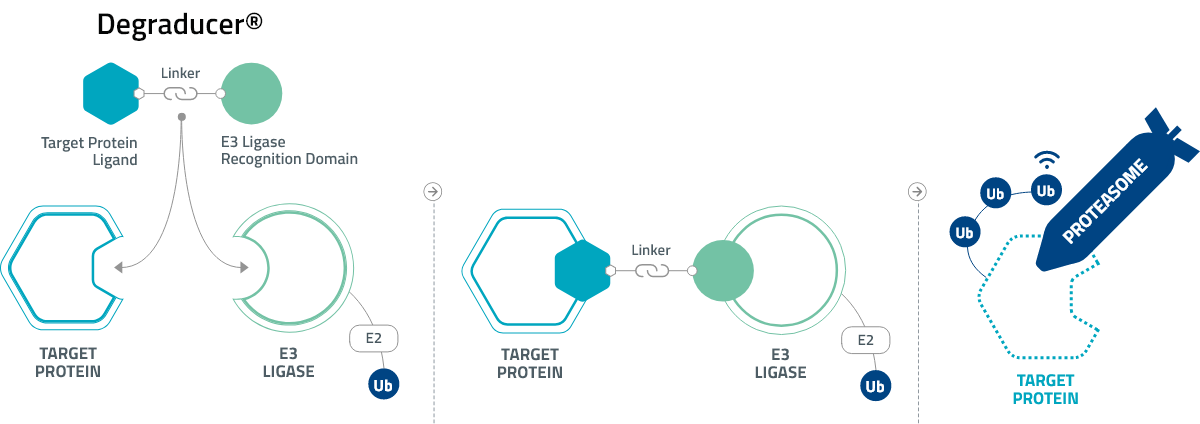
Degraducer® is a technology that utilizes the UPS system. It is a bifunctional molecule where “ligand”, which binds to the target protein, and “binder”, which binds to the E3 ubiquitin ligase, are connected by a linker. Degraducer® is a powerful inhibitor technology that enables targeted protein degradation and consequent therapeutic effects by placing a disease-related target protein nearby E3 ligase, which is an enzyme that can initiate the protein degradation system.
Medicinal chemistry
We set the criteria based on our study of protein structures for the optimal protein binder and linker characteristics to perform efficient drug design and to build a library of various E3 ligase binders and linkers which again can efficiently synthesize a number of Degraducer compounds. We are conducting systematic lead-optimization research and are accumulating physicochemical property data that are necessary for designing compounds to maintain suitable drug profiles.
Structural information
Since efficient degradation of the target protein occurs when the appropriate ternary complex between the target protein, Degraducer, and the E3 ligase is formed, it is important to understand and access information about how the target protein conjugate molecules bind to the target protein in rationale design. In this respect, we highly value structural information of target proteins, thus internal expertise is pursued along with collaboration with specialized research groups to develop the structural data-based Degraducer.
CADD (In silico screening)
In the case that structural information of target proteins is known, we have the potential to utilize in silico screening for 1) discovery of new binders, 2) acquisition of background information for the design of appropriate linkers, and 3) identification of chemical compounds and protein structural characteristics to increase selectivity or to increase the efficiency of mutant coverage, and through this, clue of detailed adjustment can be obtained for optimal Degraducer design. This background information is obtained through partnership with the best experts in Korea.
Biological assay
In screening the synthesized Degraducers, we have skilled personnel and facilities that yield accurate and reproducible data and can analyze them with maximal efficiency. From in vitro to in vivo studies, we are conducting high-quality research and accumulating research know-hows based on our study of interactions between target proteins and E3 ligase.
Novel HTS system
In order to discover onco-proteins known as undruggable targets or new E3 ligase binders, it is necessary to explore original binders using high-throughput screening (HTS). In cooperation with specialized organizations that hold state-of-art HTS systems, we are working to assess and verify candidate materials applicable to the undrugable targets and the new E3 ligase binders.
Owned E3 Ligase binder
We have a variety of E3 ligase binders in library, including original E3 ligase binders, and have the ability to derive outstanding drug candidates by developing target protein degrading agents. Furthermore, in order to expand the library of the E3 ligase binders, we continue to conduct research to discover the original E3 ligase binder.
Scientific Publications
Novel E3 ligase binders for undruggable targets
Targeted protein degradation in oncology: current status and future directions
Psychosocial effects of drug A on schizophrenia patients: a multicenter randomized controlled trial